Bitatin.internationaltrading@gmail.com
 +989331038224


 Bitatin.internationaltrading@gmail.com
+989331038224
Bitatin.internationaltrading@gmail.com
+989331038224

 Bitatin.internationaltrading@gmail.com
 +989331038224


A Practical Guide to Pruning Techniques for Higher Yield and Better Fruit Quality
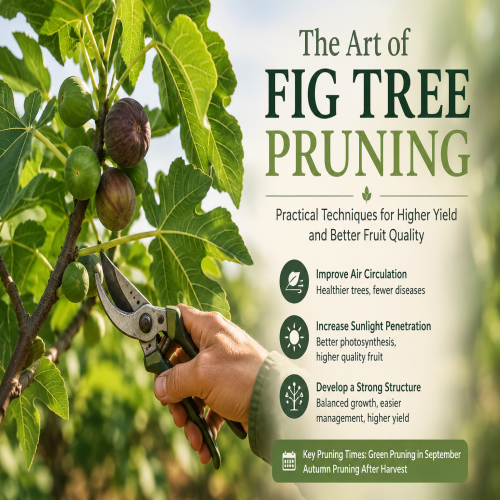
Pruning is far more than simply removing unwanted branches, it is a strategic orchard management practice that directs the tree's growth, improves productivity, and extends its productive lifespan. Proper fig tree pruning serves three essential purposes:
Removing overcrowded and unnecessary branches allows air to circulate freely throughout the canopy. Good ventilation reduces humidity around the foliage and significantly lowers the risk of fungal diseases.
Opening the canopy enables sunlight to reach the inner branches and developing fruit. Adequate light is essential for efficient photosynthesis, uniform fruit development, and improved fruit quality.
Correct pruning creates a well-balanced tree with a strong framework. A properly shaped tree is easier to manage, harvest, inspect, and maintain throughout its productive life.
Essential Pruning Techniques for Fig Trees
Successful fig orchard management relies primarily on two pruning methods, each performed at a different time of the year and serving a distinct purpose.
Green Pruning
Timing: September
One of the most common problems in fig orchards is the development of multiple trunks. This occurs when suckers (basal shoots emerging from the base of the trunk or near ground level) are allowed to grow unchecked.
Green pruning is carried out in September to remove these unwanted suckers and other non-productive shoots that interfere with the tree's natural structure. Eliminating this unnecessary growth allows the tree to direct its energy toward strengthening the main trunk and productive fruiting branches rather than supporting excessive vegetative growth.
Autumn Pruning
Managing Fruiting Branches
Autumn pruning focuses on branches that have already produced fruit during the previous growing season.
In many cases, two or three new shoots develop from a single one-year-old branch after fruiting. Retaining all of these shoots leads to excessive canopy density, increased competition for nutrients, and reduced productivity over time.
Best Practice
Select and retain only the strongest shoot that is positioned closest to the main trunk or the primary scaffold branch. Remove the remaining shoots to maintain an open canopy, preserve the strength of older structural branches, and encourage vigorous, productive growth for the following season.
Best Practices for Successful Fig Tree Pruning
Useful Links:
 About Bitatin
We proudly notify that we use the most updated and high-tech machinery like color sorting machine, a fully equipped laboratory, popular certifications like Global Gap to produce our highest quality products according to the global standards of the world to attract the customer satisfaction.
Member of the :
- Board of directors of Estahban Fig Trade Union
- National Fig Association - Board of experts of Iranian fig
 Links
Links
 Contact Us


 Follow Us